
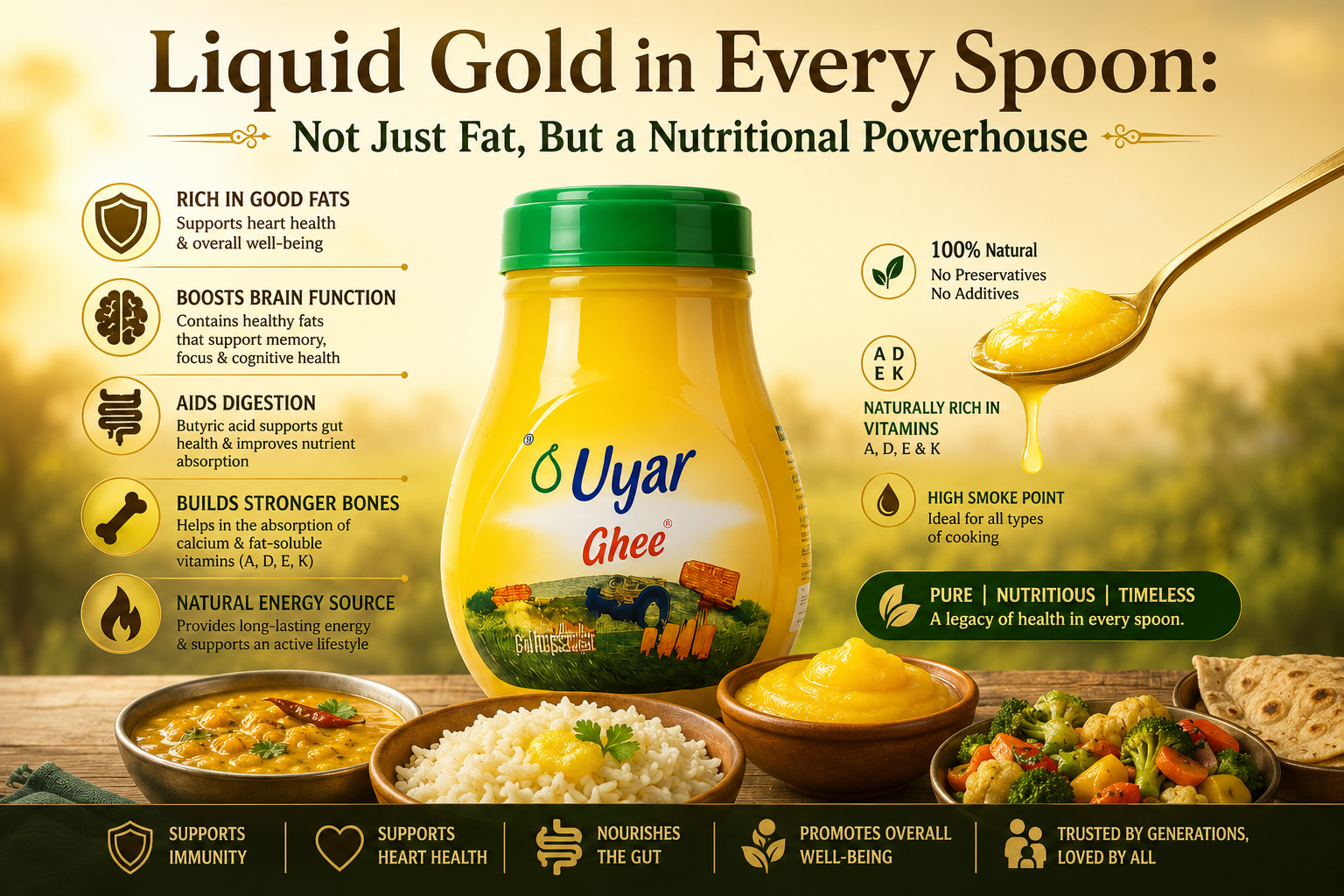
For centuries, ghee has graced Indian kitchens — and modern science is now confirming what our grandmothers always knew.
The scientific view on dairy fats is undergoing a major shift. What was once dismissed for its fat content is now being recognised for its functional health benefits.Ghee is rich in butyric acid, a short-chain fatty acid that acts as fuel for the cells lining your gut. Research confirms that butyrate reduces intestinal inflammation, supports the growth of beneficial gut bacteria, and helps maintain the gut barrier — preventing "leaky gut" syndrome.
Medium-chain triglycerides (MCTs), conjugated linoleic acid (CLA), and short-chain fatty acids in ghee have satiating properties that help reduce excess energy consumption, while also enhancing gut health. Diets higher in CLA — abundant in ghee — are associated with improved lipid profiles, better insulin sensitivity, reduced arterial plaque, and lower heart disease risk. Butyric acid in ghee also helps produce killer T-cells in the intestinal tract, directly strengthening the immune system.
Ghee enhances the bioavailability of fat-soluble vitamins A, D, E, and K — helping the body absorb these critical nutrients more efficiently, especially when consumed alongside vegetables. Think of ghee not as a guilty indulgence, but as nature's most intelligent fat — healing your gut, feeding your brain, and nourishing every cell, one golden spoon at a time. 🌿
PROCEDURE:
REMOVE DESI FROM HEADING
Step 1 — Melting & phase separation: Butter is an emulsion of fat, water, and proteins all mixed together. When heated, these three ingredients begin to separate naturally.
Step 2 — Water evaporation: As temperature rises to boiling point, all the water bubbles away as steam. The loud sizzling you hear is exactly this happening.
Step 3 — Protein coagulation: Heat causes the milk proteins (casein and whey) to unfold and clump, rising to the surface as white foam and sinking as golden-brown curds.
Step 4 — Maillard reaction: The milk solids briefly brown, triggering a chemical reaction between amino acids and natural sugars. This is what gives ghee its signature nutty, caramel-like flavour.
Step 5 — Filtration & pure fat: The solids are strained out, leaving behind nearly 100% pure anhydrous (water-free) milk fat — ghee.
The visual above is ready to embed on any website as-is. Would you like a downloadable version, a different colour scheme, or the same content adapted for social media?
Each article keeps the same layout, navigation flow, and styling so readers get a consistent experience across the whole site.